When the thing you're good at isn't as valuable anymore
I've spent a lot of my career getting really good at things AI can now do faster than I can.
I've spent decades learning how to ask better questions, make sense of fragmented information, assess the impact of complex changes and turn all of that into strategies and plans that people can actually use. Those skills took years to develop and, if I'm honest, they've become part of how I think about the value I bring professionally.
Now, with the right context and inputs, I can give some of that work to AI and get something back in minutes that's often just as good as what I would have created myself.
I find that incredibly exciting, but I'd be lying if I said it hasn't also made me stop and think.
Because when you've spent a significant part of your career becoming really good at something and suddenly technology can do parts of it faster and cheaper, it's hard not to wonder:
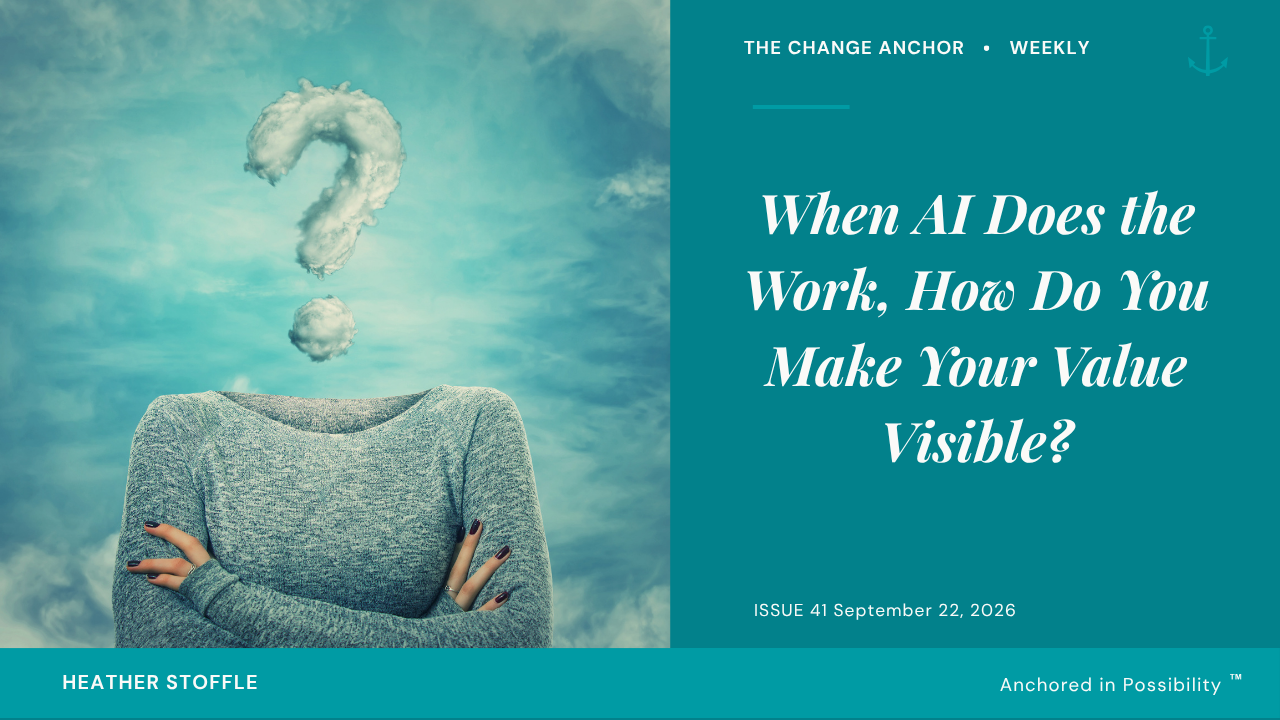
If the thing I'm good at isn't as valuable anymore, what does that say about my value?
I don't think I'm the only person asking that question right now.
I also think that we're mixing together things that aren't the same
Some of our skills really are going to become less valuable because of AI. We’re already seeing that happen with some more administrative and technical skills. I know that's not particularly comforting, but I don't think pretending otherwise helps us.
The market has always changed what it rewards. New technology appears and some skills become more valuable and others become easier to access or automate. AI is accelerating that process in ways that many of us are experiencing in real time for the first time.
Where I think we get ourselves into trouble is when we go from "something I know how to do isn't as valuable as it used to be" to "I'm not as valuable as I used to be."
Those are two very different things.
We aren't our job titles, roles or the collection of skills we've accumulated along the way. And even professionally, I think we're missing something important if we only look at the tasks AI can now perform and assume that's where all of our value came from.
The work wasn't only producing the output. It was producing you.
I’ve been thinking about this a lot lately. I've written a lot of strategic documents and change impact assessments, and I've probably asked thousands of questions along the way and AI can now help me do many of those things incredibly well.
But every time I did that work myself, I was also learning something that is really hard to pinpoint.
I learned what happened when I asked the wrong question and how to tell when someone's answer didn't quite match what was happening in the room. I learned that two situations that looked almost identical on paper could require completely different approaches for reasons that weren’t written down anywhere. I learned from decisions that worked and plenty that didn't.
Over time, all of that compounded and it changed the questions I ask, what I notice, how I read a situation and the decisions I'm willing to make. A lot of it has become so embedded in how I work and who I am that I probably couldn't document it even if I tried.
That's experience turning into judgment.
If you put me next to the version of myself from twenty years ago and gave both of us access to exactly the same AI with the same context, we'd have the same technology at our fingertips.
But I wouldn't trust us with the same decisions.
Today, I'd trust myself to make a high-stakes decision that could change the trajectory of something important in a way that I wouldn't have earlier in my career. Not because I've simply accumulated twenty more years on my résumé, but because of everything I learned while doing the work hands on during those years.
And that's making me think differently about what it actually means when AI can now do something I'm good at.
I'm seriously not interested in spending the next decade trying to protect every task I've historically been paid to do. Many of them I would gladly give up and if AI can do parts of my work faster and better, I want to take advantage of that.
What I'm much more interested in understanding is what was underneath the thing I was good at in the first place.
Maybe my value wasn't simply that I could write the strategy. Maybe it was that I could make sense of complexity and figure out what mattered when no one else could.
Maybe it wasn't creating the impact assessment. Maybe it was seeing connections and consequences that weren't obvious yet and definitely weren’t documented anywhere.
The deliverable I produced may have been the visible evidence of expertise, but it wasn't necessarily the expertise itself.
This is what I think is worth understanding about ourselves as work continues to change.
One Practical Anchor
Think about something you've historically been known for being good at and finish this sentence:
People value me because I ________.
Then go one level deeper:
What does it actually look like when I do that well?
This was a hard question for me, and I really had to spend some time with it and I encourage you to do the same. What are you noticing, questioning or connecting? What judgment are you applying? What do you understand because you've lived through situations that someone with less experience hasn't yet?
And then ask yourself:
Where else could those things create value as work changes?
Because even if the market value of a particular skill changes, no matter what you really aren't starting over. You're carrying everything you learned while developing it forward with you.
🩵 What I'm Loving
This week I'm loving a simple tool I found called My Values Card Sort.
It gives you 83 different values and asks you to sort them based on how important they are to you, then slowly narrow the list down to the handful that matter most.
I love this kind of exercise because when so much of our identity gets wrapped up in what we do, it can be surprisingly grounding to step back and ask a much more basic question: What actually matters to me?
Not what am I good at. Not what will someone pay me for. Not what's on my résumé.
What matters to me?
It's free (the authors put it into the public domain), takes about 15–25 minutes, and feels especially fitting for this week's conversation about separating who we are from the work we've learned to do.
If you want to try it, you can find My Values Card Sort here
Before you go
I think some of us are going to have to get comfortable admitting that things we've spent years becoming good at may not carry the same market value they once did.
That's uncomfortable for me too.
But I'm trying not to confuse the changing value of a skill with the value of the person who developed it.
The work you've done has shaped how you think, what you notice, how you make decisions and what you understand about people and problems. Those things may be harder to put on a résumé than a skill or job title, but they don't disappear just because technology changes how the work gets done.
Maybe the challenge now isn't holding onto everything we've always done.
Maybe it's getting much better at recognizing what we're carrying forward.
Remember, you're still the author of what comes next.
Warmly,
Heather
Anchored in Possibility™ | The future belongs to those who know who they are when everything changes.