What if AI Isn't Actually Your Problem
Every AI conversation I'm part of right now circles back to the same word: upskilling. Learn how to use the latest models, take more courses, build more agents and get them running together, get certified in as many things as you can.
The message from every direction is loud. The people who learn AI and use it every day will thrive. The people who don't will be left behind.
And so people are doing everything they can to learn as fast as they can. They're taking the courses and watching the tutorials and carving out time on their own to figure out how to do their work differently. I’m right there too - I spent five hours on Friday testing an agent and another three in classes over the weekend. For many people, it's working. They're building things, automating things, creating things they couldn't have imagined a year ago.
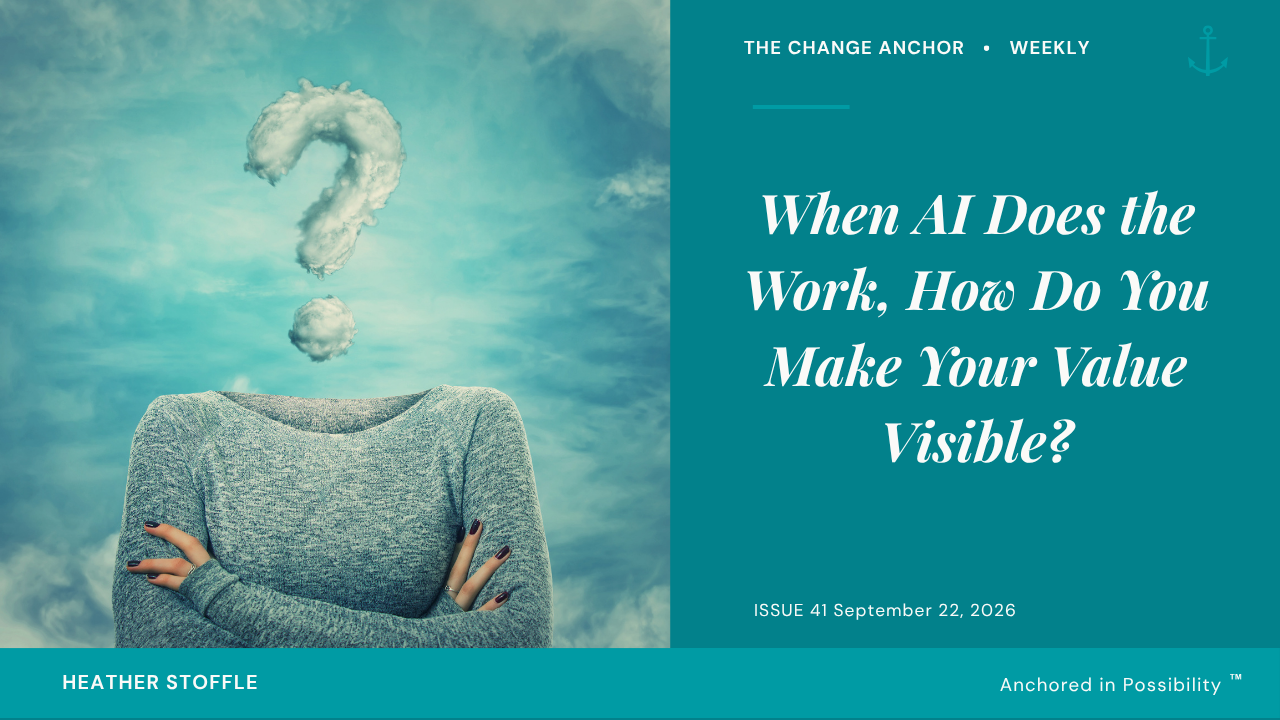
But I had a conversation recently with someone who had done all of that, had put in the time and started genuinely using AI in their day to day work, and what she told me caught me off guard. She said even though she’s learned how to do a lot and was producing incredible things with AI, she didn't like it.
Not because it was hard to do or the pace was relentless or because she couldn't figure it out. It was because the version of her work that AI was creating felt lonely. She had spent her whole career thriving in collaboration, in the energy of working through a problem with other people in the room, in the back and forth that makes a good team feel like more than the sum of its parts. And now she was sitting alone with a screen, solving problems that used to be solved together, and the work was getting done faster but it didn't feel like hers anymore.
That is not an upskilling problem. No course is going to fix it. No certification is going to touch it.
This made me stop and reflect on the massive push toward AI adoption and what it is creating for many people, which is a quiet fragmentation. People are encouraged to experiment, to try things on their own, which sounds empowering until you realize what it actually looks like in practice. You have people in the same company, sometimes on the same team, trying to solve the same problems independently with AI, each going about it based on their own skills and instincts. The collaborative tissue that used to hold teams together is thinning, and for the people who drew their energy and their sense of purpose from that collaboration, the loss is real even if they can't quite name it yet.
The AI conversation is almost entirely about capability… can you use the tools, can you keep up, can you adapt. But for a growing number of people, capability was never the question. The question, the one that keeps surfacing underneath all the upskilling and the certifications and the prompt engineering, is whether the work still feels like something they want to be doing once the way they do it changes this fundamentally.
That's an identity question, not a technology question and it deserves more than another training module thrown at it.
If you've been learning all the right things and doing all the right things with AI and something still feels off, consider the possibility that AI isn't actually your problem. Consider that the discomfort you're feeling might be information about what mattered to you about work all along, information that was easy to ignore when the work still looked and felt familiar.
That discomfort is worth paying attention to as a signal about what you might need to carry forward into whatever comes next.
🩵 One Thing I'm Loving
The Center for Humane Technology's podcast "Your Undivided Attention" did an episode called "AI and the Future of Work" with Ethan Mollick from Wharton and Molly Kinder from the Brookings Institution. It came out late last year but I keep coming back to it because it asks the question almost nobody in the corporate AI conversation is willing to sit with: can we actually create conditions for AI to make work better, or are we just optimizing our way into something nobody asked for? What I appreciate most is that they don't treat "the future of work" as an abstraction. They talk about real people navigating real uncertainty, which is exactly what I see every week. Worth your time if this newsletter resonated.
The pen is still yours. Even when the tools change, even when the way you work looks nothing like it did a year ago, the question of who you are inside that work has always been yours to answer. Nobody else gets to decide that for you.
Warmly,
Heather
Anchored in Possibility™ | The future belongs to those who know who they are when everything changes.